

Funding a Living Trust: How to Move Assets the Right Way
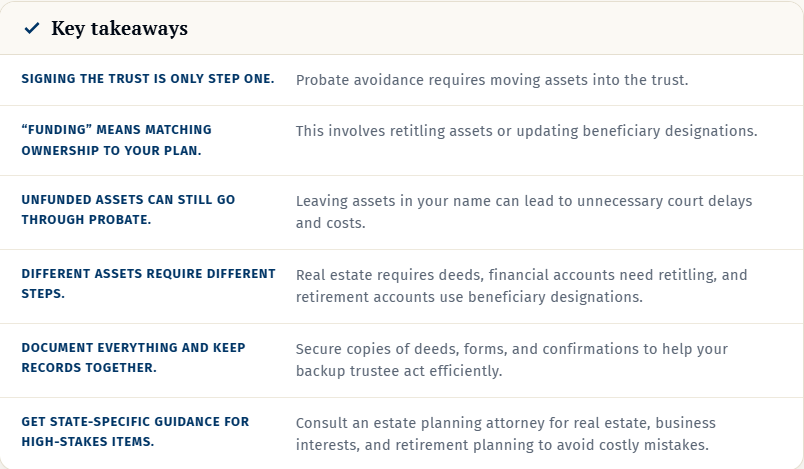
Signing a revocable living trust is an important first step, but it usually does not avoid probate, the court-supervised process for settling your estate.
To make the trust work, you generally must fund it—meaning you move ownership of your assets into the trust (or name the trust as beneficiary where appropriate). If you don't, those assets may still have to go through probate.
What Does It Mean to Fund a Revocable Living Trust?
Funding a revocable living trust means aligning your legal ownership and beneficiary designations with your trust plan so that, when you die (or become incapacitated), the successor (backup) trustee can step in and manage or distribute assets without a court process. The trustee can only control what the trust owns (or what is properly directed to it).
In plain terms, funding usually involves:
-
Retitling assets from your individual name into the trust's name (common for real estate and many financial accounts)
-
Assigning ownership interests to the trust (common for business interests)
-
Updating beneficiary designations to coordinate with the trust (common for certain insurance and retirement assets)
What If Your Trust Is Not Funded?
-
Some assets may still go through probate
-
Your family faces delays, court costs, and extra paperwork
-
Assets outside the trust may be “stuck” until moved or a court authorizes action
-
If you become incapacitated, court involvement may still be necessary to handle assets outside the trust or complete certain transactions
-
Outdated or inconsistent beneficiary designations can override your intended plan
The Core Idea: Match Each Asset to the Right Transfer Method
Different assets need different funding steps. Here's a big-picture view.
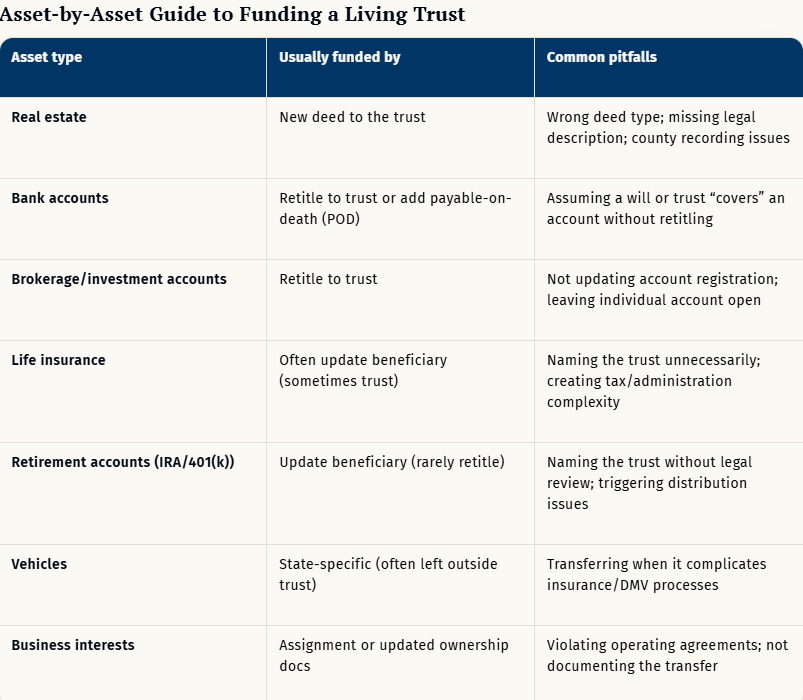
The “right” approach depends on your state's rules and your overall plan—especially for retirement accounts and businesses.
Gather Trust Details
Most banks and financial institutions will ask for:
-
The trust's exact name (example: Maria Lopez, Trustee of The Maria Lopez Revocable Living Trust dated March 12, 2024)
-
The current trustee(s)
-
The trust date
-
A Certification/Affidavit of Trust (often used instead of providing the full trust document)
-
A current list of assets and how they're titled today (statements, deeds, account screenshots)
Tip: Most institutions prefer a Certification/Affidavit of Trust. It helps protect your privacy while proving the trustee's authority.
How to Fund Real Estate (Home, Condo, Rental Property)
Real estate is one of the most important assets to fund because it's a common source of probate.
Typical Steps to Move Real Estate into a Trust
-
Confirm how the property is titled today.
-
Ask an estate planning attorney which deed type is appropriate in your state.
-
Prepare, sign, and notarize the deed transferring the property into the trust.
-
Record the deed with the county recorder/land records office.
-
After recording, confirm any needed updates with your insurer, mortgage servicer, and local property tax office.
Example (How the Title Might Look)
-
Before: Maria Lopez, an unmarried person
-
After: Maria Lopez, Trustee of The Maria Lopez Revocable Living Trust dated March 12, 2024
Important: If your home has a mortgage, transferring it to a revocable trust is usually allowed—but you still want legal guidance to avoid problems with lender policies, insurance, or local tax rules.
Real Estate Funding Checklist
-
Deed drafted correctly for your state
-
Legal description matches prior deed
-
Notarization and witness rules followed (state-specific)
-
Deed recorded and stamped/returned
-
Insurance carrier notified
-
Copy stored with estate planning records
How to Fund Bank Accounts (Checking, Savings, CDs)
Banks and credit unions have their own processes, but the concept is consistent: you're changing the “ownership/registration” of the account.
Two Common Options
-
Retitle the account into the trust (often preferred for trust-centered plans)
-
Keep the account in your name but add a payable-on-death (POD) beneficiary (simple for smaller accounts, but may not help with incapacity management)
Bank Account Funding Checklist
-
Bring Certification/Affidavit of Trust
-
Confirm new account registration wording in writing
-
Update linked bill pays/autopay and direct deposit
-
Reorder checks if necessary
-
Confirm online banking access for the trustee if needed (policy varies)
-
Ask what tax ID the bank will use for the retitled account; with many revocable living trusts, the bank can often use your Social Security Number (SSN) during your lifetime, but bank policies vary and some may request an Employer Identification Number (EIN)
How to Fund Brokerage and Investment Accounts
Brokerage accounts are often straightforward to retitle, but you must use the firm's forms.
-
Request the brokerage's trust registration paperwork.
-
Provide Certification/Affidavit of Trust and trustee ID.
-
Confirm whether the account will be retitled “in place,” or moved into a new trust account.
Note: Funding an investment account doesn't mean changing the investments. It changes the account registration (the owner), not the portfolio.
Investment Account Funding Checklist
-
Trust registration completed
-
Cost basis and history preserved (confirm with the brokerage)
-
Dividends/interest settings reviewed
-
Transfer-on-death (TOD) settings coordinated with the trust plan
Life Insurance: When to Name the Trust
Life insurance typically passes by beneficiary designation, not by retitling.
Often, naming an individual beneficiary is simplest. Naming the trust may be appropriate when you:
-
Want insurance proceeds managed for a spouse with cognitive decline
-
Have minor children or a beneficiary who needs oversight
-
Want the trustee to control distributions and timing
-
Need coordinated distribution terms across multiple beneficiaries
Naming the trust can add administrative steps, so it's often not necessary unless you need ongoing management.
Life Insurance Checklist
-
Beneficiary designation reviewed and updated
-
Contingent (backup) beneficiaries named
-
Trust name matches exactly (if used)
-
Copy of beneficiary confirmation saved
Retirement Accounts (IRAs and 401(k)s): Usually Beneficiary-Based, Not Trust-Owned
Most retirement accounts are not retitled into a living trust. Instead, you typically update the beneficiary designation.
Naming a trust as beneficiary can be risky—get legal guidance first.
Retirement Account Checklist
-
Primary and contingent beneficiaries reviewed
-
Spousal consent rules followed (common with employer plans)
-
Records saved (screenshots/forms/confirmation)
Vehicles: A State-By-State Decision
Vehicle titling rules vary by state, so confirm the best approach before retitling.
-
Check your state's transfer-at-death options for vehicles
-
Ask your insurer whether trust titling affects coverage or liability
-
Ask your attorney whether or not retitling helps your plan
Business Interests: Limited Liability Companies (LLCs), Partnerships, and Closely Held Companies
Funding a business interest depends on the entity type and governing documents.
-
Review the operating agreement/bylaws for transfer limits
-
Sign the correct assignment/transfer documents
-
Update company records (member ledger, stock ledger, or ownership records)
-
Coordinate with your attorney (and certified public accountant if needed)
Is Your Trust Funded?
Ask yourself:
-
Do my deeds show my trust for property I want in the trust?
-
Do my key financial accounts show a trust registration (if that's the plan)?
-
Are my beneficiary designations updated and consistent?
-
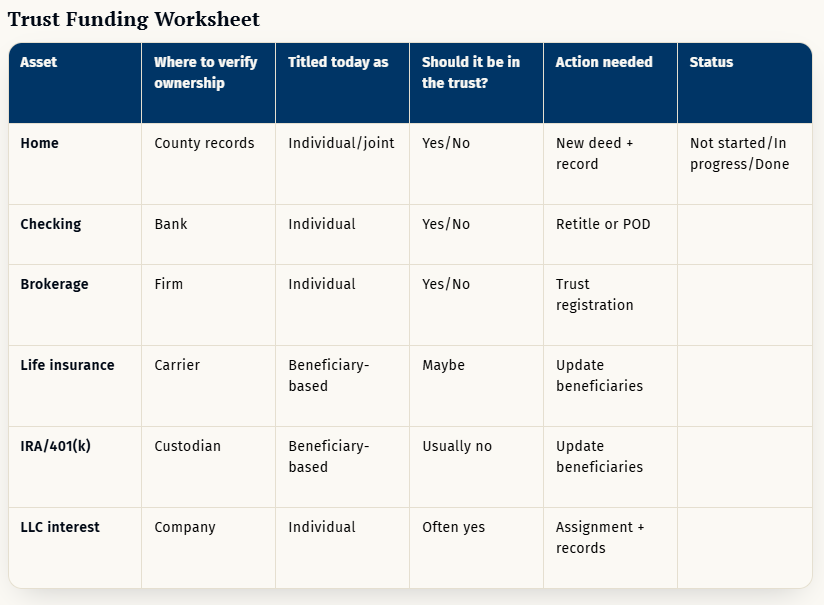
Could my successor trustee find the documents and access the accounts?
If you're unsure, you're not alone. Trust funding is one of the most common “unfinished steps” in estate planning.
When to Get Help
Many people gather statements and request institution forms on their own. Work with an estate planning attorney when you:
-
Are transferring real estate (especially properties held in multiple states, which can trigger different rules in each)
-
Are considering naming a trust as beneficiary of retirement accounts
-
Own a business interest (LLC, partnership, closely held company)
Source: Funding a Living Trust: How to Move Assets the Right Way

Comments
There are no comments for this post. Be the first and Add your Comment below.
Leave a Comment